Abram Rubenchik
1927

The story of Abram Rubenchik is a remarkable and tragic account of a Jewish boy who was destined to pass through the circles of hell of the Nazi ghetto, to lose almost his entire large family, and to survive in order to tell the truth. Abram, his older sister Ekha, and his cousin Ginda became symbols of an unbreakable will to live and to resist.
Abram (in the family he was affectionately called Avremele) was born in 1927 into the large family of Israel and Nakhama Rubenchik. He was the second of seven children: Ekha, Abram, Elya, Gesl, Khaya, Yarukham, and the youngest little sister, Tayba. The family lived in their own house on Zelyony Lane, in the northwestern part of Minsk. Almost all their neighbors were Jews. His father worked as a plasterer and painter; in winter he would sometimes hire himself out to cut ice from the Svislach River. They lived modestly but in harmony. The Rubenchiks were likely long-time residents of Minsk: even Abram’s grandfather, Gesl Rubenchik, before the Revolution, transported sand that was extracted from a quarry on Ratomskaya Street. Once, having grown very tired, he lay down to rest on damp sand, caught a chill, and died of pneumonia at the age of fifty-four…
Abram’s father, Israel Rubenchik, had five sisters and five brothers. Almost all of them lived nearby. Abram remembers them by name: Aunt Tayba (killed with almost her entire family on “Bloody Monday”—we will return to this), Uncle Khaim the stove-maker (killed with his wife and children), Aunt Yudes the cook (killed with her daughter), Aunt Eshka with her husband Leybe Shifrin and their three children (all were killed), Aunt Genya Soloveychik (killed with her husband and son Gesl; her daughter Maya miraculously survived and later moved to the United States), Aunt Sima (joined the partisans), Uncle Leva (went to the front; his family was killed), Uncle Lazar (a teacher at a dental school, went to the front, returned, later moved to Israel), Uncle Aron (killed with his family), and Uncle Genakh. The tragic fate of Genakh Rubenchik is an example of the brutal antisemitism Jews faced even in the partisan forests. During a march, his feet were rubbed raw and bleeding, and when Genakh fell behind the column, the commander caught up with him and personally shot him with a submachine gun, stating that he was getting rid of “extra Jews.”
In his memoirs, Abram warmly describes his childhood: how they—laughing, merrily splashing little children—were bathed in a tin basin; how, if someone fell ill, their mother would buy sweet halva and a rich bun—this was a real celebration. He recalls how his father would put on a tallit in the mornings and pray, swaying, and after the prayer would unwind the black strap of the tefillin from his arm.
Abram studied his first three grades at Jewish School No. 30 on Internatsionalnaya Street. His teacher’s name was Faina Kaplan—among themselves, the children good-naturedly joked about her, recalling her far more famous namesake who had attempted to assassinate Lenin. Later, the school was closed, and Abram transferred to the fourth grade of Russian School No. 12. He attended drawing, chess, and checkers clubs at the Palace of Pioneers. With neighborhood boys, he played cards, lapta, “mayalki,” and “nozhiki.” From about the age of ten, the boy earned money through physical labor: sawing and chopping wood, gathering hay, unloading watermelons at the market, carrying crates. “I was happy that I could help my family,” he recalls.
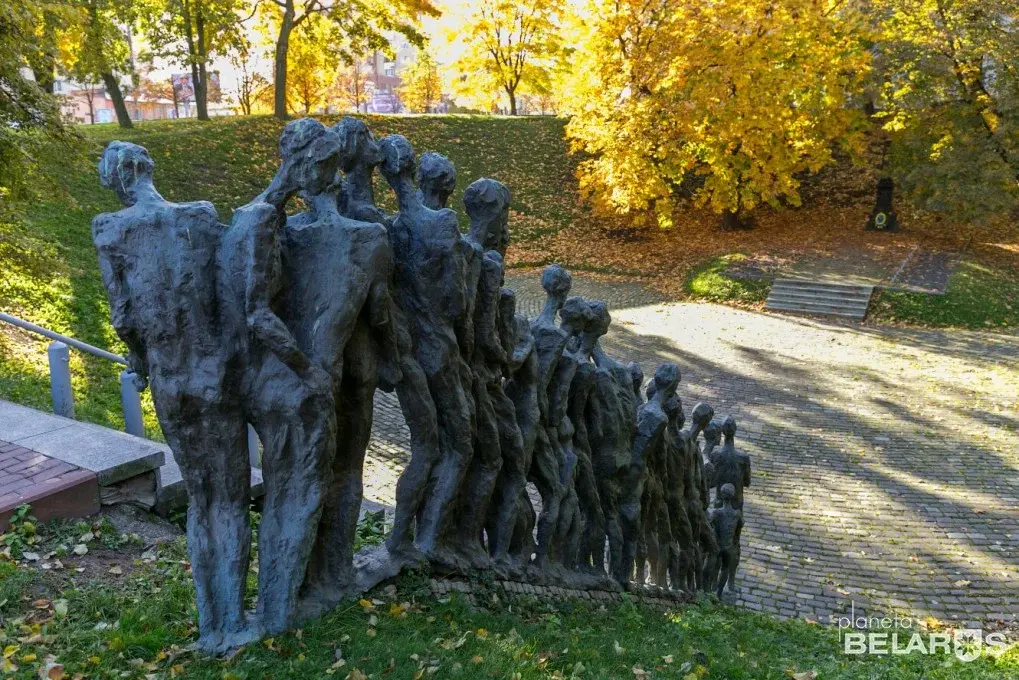
In winter, Abram loved skiing. The steep slopes ending at the Pit were perfect for such outings. This place our hero would never forget. Back then, in his cloudless prewar childhood, he could not have imagined that during the horrific pogrom on March 2, 1942, the Nazis would shoot about five thousand prisoners of the Minsk ghetto at the Pit. Many victims—including around two hundred orphans from an orphanage, along with medical staff and caregivers—were thrown into the pit while still alive and then covered with earth. In 1947, a commemorative black obelisk would be erected here, and half a century later it would be complemented by the sculptural composition “The Last Journey” by architect Leonid Levin.
On the morning of June 22, 1941, Abram was at the opening of Komsomol Lake. Like many schoolchildren, he and other boys had worked there during a community work day, pushing wheelbarrows of soil and tamping the ground. The children worked willingly, joked, laughed, and sang songs. And suddenly, one of the adults said: “War!” Abram recalls: “At first we didn’t even understand what it was. But when we returned home, from the worried faces of the adults we sensed: something unexpected and irreversible had happened.” Alarming rumors began to spread through the city: the Germans had dropped a paratrooper landing on the outskirts! Panic began.
On June 24, Minsk was subjected to a massive bombardment. The headquarters of the Western Front, the government of the republic, and the leadership left the city, moving to Mogilev. Incendiary bombs fell on residential districts, fires broke out everywhere—wooden houses, which had made up the overwhelming majority of Minsk’s housing before the war, burned like candles.
Anxiety was growing in the Rubenchik family. Relatives gathered—the father’s brothers and sisters. A dispute broke out: what should they do? Many had no doubts—they had to flee the city, escape the fire and bombings as quickly as possible: find a horse and cart, pack the essentials, and head east, following the retreating army. Others hoped that everything would pass. “We are working people—what do we have to fear?” someone argued. “There are no Communists among us…” Everyone was waiting for the father’s older brother, Aron, to arrive. Because of her fair hair, his wife Masha was nicknamed “Mashe di Gele” (from Yiddish—Masha the Fair). Educated and pleasant, she was considered intelligent and authoritative within the large Rubenchik mishpokhe. They began asking her opinion. Abram remembered a phrase Aunt Masha said in Yiddish: “To abandon bread and go looking for scraps? No, I will not agree to that!” Similar discussions were taking place among the neighbors—everyone was worried and arguing. At that time, in the USSR, people still did not know that the Germans were persecuting Jews. And the family stayed in Minsk…
Meanwhile, tension in the city was rising. Shops were closed, and the market stood empty. In the former mosque on Dimitrov Street there was a food warehouse—on June 25, people began to carry food away from there. Abram did not hesitate either: he rolled out a small barrel of margarine and dragged home a box of candies—his favorite “pillow” caramels. “Later, when there was no food, these supplies were very useful for our family,” he recalls.
Near the former mosque, the boy saw Germans for the first time. They rode onto Dimitrov Street on a motorcycle with a sidecar. Abram clearly remembered their gray-green tunics, Parabellum pistols on their belts, and Schmeisser submachine guns on their chests. An officer jumped off, pulled out his pistol, and fired into the air, dispersing the crowd. Entering the mosque building, he shouted: “Was ist da los?” (“What is going on?”). Frightened people pressed themselves against the walls; no one answered. Some time later, the Germans left, and the frenzy of looting continued until late at night. Stearin candles were especially valued—there was no electricity, and fights would sometimes break out over them.
Abram returned home proudly with his “trophies,” feeling like a provider. His mother, however, shook her head sorrowfully: “What people have come to—everyone is looting…” Soviet money immediately turned into useless scraps of paper. At first, it lay scattered on the sidewalks; boys burned it in bonfires. Later, an exchange rate was established: ten rubles for one occupation mark.
Soon, SS men appeared in Minsk. They roamed the streets, sometimes accompanied by interpreters, finding out where Jews lived, entering apartments, searching for valuables: “Gold! Gold!” This was an order of the occupation authorities—to confiscate Jewish property, first and foremost gold and silver: rings, earrings, tableware, candlesticks, watches. But what was far worse, the SS carried out a “selection”: they seized young Jewish men and took them to prison (many of them would later end up in the concentration camp in Drozdy), releasing only those with needed professions—stove-makers, masons, painters, plasterers.
At that time, Abram still did not understand why the Germans were so aggressively disposed toward Jews. Later he realized, learned through terrible experience: it was a deliberate policy that blamed his people for all misfortunes. The researcher of Nazism, historian and playwright Hannes Heer, later wrote: “The hunting of Jews and their extermination were not carried out accidentally or spontaneously. There existed a clearly developed, approved system… The desire to kill, sadism, cruelty… could not arise by order. These qualities were inherent in a significant part of the servicemen. But the orders of commanders provided the pretext for these instincts to come out.”
Abram Rubenchik recalls the concentration camp in Drozdy—one of the first in occupied Belarus. On the northwestern outskirts of Minsk, right by the Svislach River, the Germans created a temporary camp that later became the notorious “Stalag-352.” In the July days of 1941, a large group of prisoners of war—ten to fifteen thousand—was driven onto a vast area. All were made to sit directly on the bare ground; the territory was fenced with ropes, and machine guns were set up at the corners. All Jews arrested in the first days of the occupation, aged from eighteen to forty-five, were brought there as well.
In The Black Book by Ilya Ehrenburg and Vasily Grossman, there is an account by a man who had been in Drozdy: “On the first day, thousands of people were left to spend the night in an open field. It was cold, but everyone lay close together and thus kept each other warm. On the second day, everyone was thirsty, and each person approached the guards and asked for water. In response, the Germans shot at people… On the third day… an interpreter appeared with an officer and announced that until four in the afternoon, relatives would be allowed into the camp with food parcels… But then we heard the cries of weeping women. People asked: why are you crying? And immediately we heard the answer: our husbands and children are no longer there—they have been killed…”
Abram, in his memoirs, confirms this: every day, hundreds of Minsk residents rushed to Drozdy in the hope of finding their relatives—but not many were fortunate… After the war, historians established that during the occupation, at least eighty thousand people perished in the camp.
Even before the official establishment of the ghetto, looting and killings began in Jewish neighborhoods. Abram’s father broke down the interior partitions and made internal wooden shutters for the windows. He suggested that his sister Tayba, who lived across the street in house No. 20, do the same. But she refused: “God has protected me until this day; He will protect me further.”
One night, the sound of shattering glass rang out. Then came blows against the windows and the door. Everyone froze in fear. From the street came German curses: “Verfluchte Juden!.. Schweinerei!..” (“Cursed Jews!.. Swine!..”) The internal shutters saved the family. Everyone rushed into the malina—a shelter dug into the ground.
Hiding, they heard indistinct sounds and gunfire. After some time, everything fell silent. In the morning, there was a knock at the door. A crying child’s voice in Yiddish pleaded: “Lozt mikh arayn! Lozt mikh arayn! Bay undz hot men alemen geharget!” (“Let me in! Let me in! They have killed everyone at our place!”) It was their cousin Ginda. Everyone ran to the house across the street. What they saw there Abram would never be able to forget: thirteen bloodied bodies—on the floor, on the beds, on the sofa, in the kitchen. Aunt Tayba lay on the floor; beside her, in the bed, was her daughter Khaya’s little son, the first grandson in the family. Khaya herself, the eldest daughter, lay with her chest torn open, and around the wound were what seemed like marks of claws driven into the flesh. “It seemed that only a wild beast could leave such a wound…”
Sobbing, Ginda recounted the details of that night. The SS men broke in after midnight. There were four of them, wearing red armbands with swastikas, armed with Parabellums. The senior one shouted: “Is there any gold? Hand it over!” The father said there was no gold. Then the officer said something to the others; they took positions by the exits, while he himself grabbed Khaya and dragged her into a separate room. She screamed and resisted. The brute raped her, then shot her and rushed out in a rage. Another German seized little Dinka. She broke free and began throwing dishes. The German flew into a fury and started shooting. The senior officer killed the mother, who had tried to shield Mina and Sofa with her body. He wounded little Gesl in the stomach as he lay on the stove. Then he fired several shots at the father. He fell and pinned Ginda beneath him—this saved her life. The girl was covered in blood and pretended to be dead.
How long it lasted, Ginda did not know. She only remembered that the officer said something in German, and they all left. She did not understand that her relatives were dead—it seemed to her that they were sleeping. She went from one to another, trying to wake them, shaking them. Only the wounded Gesl on the stove regained consciousness. She helped him down and dragged him to the bed…
Ginda listed those who had been in the house: her mother Tayba, her father Eli, her little sisters Mina, Sofa, Dinka, Ester, her little brother Gesl, Khaya’s one-and-a-half-year-old son, Gershn Slepak with his son, her father’s brother Meysl with his wife and children… In total, twenty-two people; thirteen of them were killed. Abram called that terrible day “Bloody Monday.” But it was only a precursor of the nightmare that awaited the Jews of Minsk ahead.
On July 19, 1941, the military commandant’s office of Minsk issued an order establishing a Jewish ghetto. Its text, in German, Russian, and Belarusian, was posted in prominent places. The order required Jews to move within five days to designated streets. Violation of the order meant execution; hiding Jews meant execution of the entire family.
A real crush began. Jews from all over the city moved to the streets assigned to them. Trams were not running, so adults with children made their way as best they could—hauling their belongings on carts and wheelbarrows. Some hired porters, but taking advantage of the confusion, they sometimes disappeared with the belongings. “It is impossible to describe the din, the noise, and the crying that accompanied the resettlement,” Abram recalls.
The ghetto area consisted mostly of wooden houses. All the streets were enclosed with barbed-wire fencing: two-meter posts, with barbed wire stretched between them every twenty centimeters. “Of course, for us nimble boys it was nothing to get over this barrier. We went into the city anywhere and at any time. We still did not understand that this involved great risk, that one had to be very cautious. God forbid if you were caught at such a moment by gendarmes or the commandant himself—they would shoot you without a word,” Abram writes.
Among the Jewish youth, anger was growing. Rumors spread that the first groups of boys had already gone into the forests to join the partisans. Among them were Mikhail (Mikhel) Gebelev, Naum Feldman, and Zyama Okun. In the spring of 1942, twenty people led by Israel Lapidus successfully reached the forest near Slutsk. This was the first partisan detachment whose core consisted of fighters from the Minsk ghetto.
In the autumn of 1941, the Germans carried out public executions in four different places in Minsk at the same time—they hanged twelve patriots who had been rescuing wounded prisoners of war and helping them escape to the forests. Those sentenced to hanging were led from the city prison to the sound of drums. A young girl had a placard hanging on her chest stating that she was a partisan and had fired at German soldiers. This was a fabrication of Nazi propaganda. In reality, she had not shot at anyone. It was Masha Bruskina, a courageous underground resistance member who helped save Jews.
On November 7, 1941, the anniversary of the October Revolution, the Germans began a “cleansing” of the ghetto. Their goal was to destroy as many Jewish families as possible in order to free part of the territory for Jews deported from Germany. At that time, Abram and his family were living in the 2nd Opansky Lane—his father, as a fakh-arbayter (a skilled worker), had received an apartment there. The house was a single-story, multi-apartment building with a large Russian stove. Abram and his older sister Ekha immediately arranged a malina, so that there would be a place to hide—using the inner cavity of the stove and the crawlspace beneath it (called a “poplec”), from which they scooped out sand, expanding the shelter.
Early in the morning of November 7, the pogrom began. The Germans and the police surrounded part of the ghetto, announcing that people were being sent to work. Those who hesitated were driven out with rifle butts. The columns were marched to Tuchinka, to a quarry where pits had already been prepared. People were shot with machine guns. Children were pushed into the pits alive. Police from the Judenrat (the body of Jewish “self-government” organized by the Nazis) were forced to lay out the bodies. Some of the policemen could not endure such “work” and tried to refuse—the Nazis shot them without hesitation as well.
At that time, Abram and his father were at work. For two days they were not allowed into the ghetto. When they returned, the father rushed to the malina. Pale as a sheet, he called out to his wife: “Nakhama! Nakhama!” And she answered—all of them were alive. “We embraced each other and cried with joy,” Abram recalls.
On November 20, a second pogrom followed. Abram remembered the story of Girsle der Starker: an elderly man of heroic build broke out of the column of those being led to execution, threw himself at a German, knocked him to the ground, and bit off his nose—after which he was shot… The Rubenchik family survived this time as well: Uncle Aron led the household out using a specially obtained pass. On the way, a Vlasovite noticed Aunt Masha’s gold teeth and wanted to knock them out with a bayonet—by some miracle, they managed to persuade him to let everyone go, promising to hand over the gold afterward.
In October–November 1941, trains with Jews from Germany, Austria, and Czechoslovakia began arriving in Minsk. The “resettlers” were assured that they were being taken east to help rebuild cities—they were even promised a passenger train. Instead, they were crammed into freight cars. Upon arrival, they were settled in a separate district—the “Sonderghetto.” Contact with prisoners from other parts of the ghetto was strictly forbidden; the belongings they had brought were quickly exchanged for food, and as a result, the German Jews suffered from hunger even more than the locals. At the same time, they maintained perfect order in their area and demonstratively observed the Sabbath. At first, German Jews naively believed that after Germany’s victory they would be returned to their homeland. However, the Nazis destroyed them with the same methodical efficiency as the local population: according to German historian Monika Künzler-Kingreen, out of fifteen and a half thousand deportees, only five hundred survived until liberation.
The first winter in the ghetto was terrifying. In unheated, often half-ruined houses, weakened and sick people died from cold and hunger. At that time, Abram’s family numbered fifteen people. The children slept on bunks, while the adults listened through the night. Hunger was relentless. What helped was “barter”: Abram and his friends exchanged goods for food with peasants, sometimes even managing to resell it. But this “business” carried mortal danger: each time, the boys had to leave the ghetto. Once, after trading his father’s shoes for flour, Abram was caught in a roundup and, fleeing pursuit, lost all his “trophies.” At home, the younger children met him with pleading eyes—and he did not even have a crust of bread. “My dear little ones, forgive me for not being able to feed you…”
Food was also obtained at the freight station: they stole it from railcars. Once, Abram was caught by soldiers guarding the station. And not only caught—they also took away a jar with a double bottom in which the most valuable thing was hidden—a small amount of German marks. The boy was beaten, but he still managed to persuade them to return the jar. Abram thought the soldiers were Italians—they were usually not as cruel as the Germans. Overjoyed, our hero grew bold: having run about fifty steps away, he shouted in German, “But I have marks!” and made a rude gesture.
Another time, fleeing pursuit, Abram and Ekha hid in a brick well and nearly suffocated—steam was pouring from a nearby pipe, and it soon became hard to breathe in the shelter. That day, more than a dozen boys known to Abram were caught and shot. Brave Yankele Kuper survived: he had so many lice that they were afraid to touch him, and Yankele managed to escape.
Occasionally, real miracles happened. Once, Abram’s younger brother Gesl was rummaging through the ruins of a house and found several gold coins—five-ruble pieces from the tsarist mint. “Where did you get this?!” the father cried out joyfully when he saw the gleaming discs with the profile of Nicholas II. Israel, together with Abram and Gesl, immediately ran to the place of the find, but other children were already swarming there, and the Rubenchiks found nothing more. Still, even this handful of coins was a real fortune: they managed to buy several buckets of potatoes, butter, salt, and a sack of flour. The family gained a supply of food, and Gesl walked around proud—he had managed to help his relatives so much.
At the beginning of December 1941, Abram’s older sister Ekha suddenly disappeared. Everyone in the house was in tears: Ekha was deeply loved for her cheerful, resilient nature, for her courage and resourcefulness. A few days later, everyone breathed a sigh of relief—she returned. It turned out that she and her friend Fanya had tried to reach Radoshkovichi in order to find partisans. Along the way, they saw trucks carrying Jews to their deaths, heard cries in Yiddish; they spent nights in haystacks and barns. Having failed to find the partisans, tired and disappointed, the girls returned to the ghetto. This experience, though unsuccessful, taught Ekha a great deal. She realized that a successful escape from the ghetto required organization, knowledge of the terrain, and help from outside.


…The day of March 28, 1942, began like a real celebration. The day before, Abram and Ekha had brought back a sack of potato peelings, and their mother decided to make real draniki—golden, crispy potato pancakes. The children were full, perhaps for the first time during the occupation. In the morning, as usual, Abram and his father went to work—repairing the house of Gauleiter Wilhelm Kube, while Ekha and her brother Gesl went to the brick factory. At home remained Elya, Khaya, Yarukham, and little Tayba. That day it was announced that all non-working residents had to gather at the Judenrat. According to rumors—for the distribution of new badges…
Unaware of anything, the children went to their grandmother Tsipa. Their mother, wrapping Tayba in a scarf, hurried after them. But suddenly, shooting broke out in the street—people began running, dogs barked frantically. The way to their grandmother was cut off. The mother returned, laid the sleeping Tayba on the bed, covering her with a scarf, and went down into the malina.
Just a few minutes later, SS men burst into the house. They smashed everything in their path, firing their weapons. Eleven people hid in the malina: the words of prayers could barely be heard, and the pounding of hearts seemed louder than a tolling bell. At that moment, Abram had climbed onto the roof of the Gauleiter’s house and saw how dogs were set upon people in Zamkovaya and Dimitrova Streets, how an old man with children was being pushed into a gas van…
Only on the fourth day were the workers allowed back into the ghetto. At the gates, Abram and his father saw a horrifying sight: carts piled with corpses mixed with bloodied body parts, dark pools of blood in the dust. Abram would see this in his dreams for many years afterward. They ran to the house—everything was smashed and looted. It was the first time in his life that his father cried. He shouted: “Open up, it’s me, Israel!” The mother appeared, looked around wildly, held out a scarf with two bullet holes in it, and burst into tears as well. In the malina, exhausted people had been hiding for four days without water or food. Little Dana, Freyda’s daughter, cried and begged for water. To save everyone, someone suffocated the girl…
On that nightmarish day, Abram lost five brothers and sisters—of the seven children, only Ekha and he remained. Ekha, who had also been kept out of the ghetto for a long time, managed to help her little brother Gesl jump off a truck when he was being taken to be shot—but Gesl was never seen again; he, too, passed into eternity…
“I saw that Mama … was on the verge of madness. With inflamed eyes, her hair disheveled, she looked like a madwoman. Papa began to calm her. And the scarf in which Mama had wrapped little Tayba was all stiff with dried blood and had two bullet holes in it. ‘Vu iz mayn Taybele!’ (Where is my little Tayba!)—her cry rang out. A deathly silence followed. With eyes wide in horror, Papa and Mama looked at each other. They did not believe it; they still could not comprehend what had happened. … That day, Papa turned completely gray. And Grandmother Tsipa … stopped speaking and would not touch food. We tried to feed her by force, but it was useless. She moaned and shook her head, pushing people away. A month later, she died.”
After the March nightmare of 1942, the thought of escaping the ghetto never left the Rubenchiks—in essence, it was their only chance to survive. Ekha, who already had experience searching for partisans, now acted decisively and in an organized way. Help came from a Belarusian woman, Natasha Shuneyko, who worked with Ekha at the brick factory. Natasha gave them an address in Staroye Selo, where her relatives lived and were ready to help. During the war, Natasha Shuneyko survived. The surviving Rubenchiks remained friends with her; after the liberation, they often gathered together, recalling what they had endured and the relatives and friends who had died too soon…
At the beginning of March 1943, Ekha and her friend Fanya Kaplan—the same one with whom they had tried to escape a year earlier—set out for the forest again. This time they were fortunate: they met a partisan from Staroye Selo, who brought the girls to the detachment.
Soon, Ekha returned to the ghetto, dressed as a peasant woman—in a colorful jacket, a black faux-fur coat, and a wide skirt, carrying a basket of eggs and a jar of sour cream. She proudly announced: “I am a partisan now! I have been accepted into a detachment! And I have come to the ghetto on assignment from the command!” Her relatives could not believe their eyes; their joy knew no bounds.
Ekha made the decision: “Whoever is ready—we leave this evening.” Preparations were rushed. Ekha gave instructions: take only the most valuable things—gold, earrings, brooches—to exchange with peasants for weapons; move at night, keep distance, do not get separated. Abram and his cousin Ginda rushed to notify trusted friends and acquaintances who had long dreamed of escaping to the forest. These were their own people, tested by the harsh life in the ghetto: Yankele Kuper, Khaim Goldin, Beta, Larisa, Grishka the dancer.
When it grew dark, in different places, in small groups, they slipped under the barbed wire and left through the Russian district. Abram put on a new winter ushanka hat and raised his collar higher so that his “Jewish” nose would not stand out. In general, he dressed as neatly as possible—according to their cover story, a Russian groom was being led to his bride by two of her friends.
They walked twelve kilometers. Ekha was exhausted—she had not slept for more than two days, and the women helped her along. At last, they reached the forest near Staroye Selo; in places, snow still lay on the ground, it was damp and cold. They flinched at every rustle; from afar came the howl of wolves. When dawn finally broke, they came out to the forest edge—huts could be seen in the distance. The fears of the night forest receded, but Ekha warned them: on the contrary, among people they needed to be especially vigilant. She went with two girls to scout the village, while the others hid in the forest. But everything turned out well: there were no punitive units in Staroye Selo.
The fugitives were taken in by a woman connected with the partisans. She advised them to look for weapons in the forest—there Abram and his friends, over time, found all sorts of “things”: bolts, barrels, clips with cartridges, gas mask bags. Our hero came across an intact carbine, greased with fat. Abram attached a strap to the stock—taken from his trousers—and tied a rope around his waist. Proud and happy, the young man immediately felt like an adult.
Getting into a detachment was not so simple: the partisans appeared in Staroye Selo rather rarely, and ordinary “avengers” did not have the necessary authority. But one day Abram was lucky. Commissar Ivan Petrovich Kazak, who had earlier accepted Ekha into the detachment, appeared in Staroye Selo. When Abram saw him, he approached and asked to join. Kazak asked: “And what will you do with us?” — “Go on reconnaissance. I even have a carbine!” Abram blurted out. The commissar smiled and ordered that he be enrolled in the detachment.
His mother, who had been watching this scene, burst into tears: “Go, go, my son! You and Ekha will avenge everything and everyone.”
On his very first day, Abram was posted on watch at the outskirts of the village of Lisovshchina. An experienced partisan taught him how to use the carbine: showed him how to load and unload it, how to aim, and how to care for the weapon. Abram stood on watch for about five hours—it felt like an eternity. He was unbearably hungry. Finally, two partisans came; one of them relieved him. Exhausted and frozen, Abram was taken to headquarters and given a rich potato soup with meat. He ate endlessly—he could not get enough. Then, unnoticed, he stuffed some meat into his pocket, cutting through the lining—just as he had once hidden food in the ghetto. He asked the commander for permission to visit his mother and his cousin Ginda and brought them a loaf of bread. After that, he did not see his mother for a year, almost until liberation—but he knew she was alive.
Partisan “daily life” was packed with events. Abram took part in reconnaissance at the Olekhnovichi station, gathering information on the schedules of German trains. During a raid on the Volozhin police station, young Rubenchik showed particular courage: he was the first to burst into the house of the local collaborators’ leader and, not giving him time to react, took him and his brother prisoner. Later, the “tongues” from Volozhin proved invaluable in identifying traitors.
The partisans caused the Germans serious trouble, and at some point, determined to crush them once and for all, the Nazis blockaded the forest: the detachments found themselves encircled. Abram and several other boys (among them his old friends Yankele Kuper and Khaim Goldin) were posted on watch. Their leader, Vanya Khokhlov, went off to get food and disappeared. For three days they sat almost without food, listening to gunfire. Then they headed toward the camp—but the Germans were already there. They moved toward the swamp—the only place the Nazis feared to enter. Mosquitoes tormented them relentlessly; at times the boys waded chest-deep through the mire. Five days later, exhausted, they finally encountered a partisan detachment. Abram was so weakened that he had to be carried on an improvised stretcher. Two former prisoners of war—Kostya Rozhkov from Saratov and another young man from Kuban—carried him through the swamps and did not let him die.
But everything happened in partisan life. Once, a drunken partisan tried to exchange Abram’s carbine for something, and when the boy refused, he pinned him against the wall and pulled out a pistol: “You little Jew! I’ll count to ten: one… two… three…”. Fearless Ekha came to the rescue: she struck the drunk man’s hand with the butt of her submachine gun with all her strength, and he collapsed to the ground with a broken arm.
Abram recalls another example of blatant antisemitism. After a successful operation (they had managed to derail a German train and delay railway traffic for a long time), the partisans drank in celebration and were returning to camp through the forest on a cart. A Jewish man, Podberezkin, was driving the horse, with three others sitting behind him. A drunken partisan, Kozlov, quietly suggested “finishing off that Jew,” and his companion—also heavily intoxicated—did not object: “If you want to, do it. To hell with him.” With a shot, Podberezkin had half his head blown off. The horror of what had happened sobered the partisans instantly. But, fearing punishment, the squad leader tried to cover up the incident: they reported that Podberezkin had been killed by a German bullet. However, by that time the partisan movement was already fairly organized; in larger formations there were counterintelligence officers, and the whole story aroused serious suspicion. The investigation that followed established the truth. Those involved could not evade responsibility and gave detailed testimony. The squad leader who had concealed the truth was shot, and the killer—apparently a convinced antisemite—was publicly hanged in disgrace.
One episode remained especially vivid in Abram’s memory. Once, Ekha went on guard duty and… fell asleep. It had never happened to her before—despite constant exhaustion. As fate would have it, her grave mistake was noticed by the commander of the partisan brigade. Ekha Rubenchik was put on trial; one of the platoon commanders had already announced the sentence—for a serious breach of discipline at a combat post… Execution! All of this took place before Abram’s eyes—the unit was lined up in a clearing, and Ekha stood in the center, her face pale and rigid. She did not say a word.
Abram could not believe what was happening: execution?! His Ekha—fearless, brave, never losing heart. Ekha, who had saved what remained of the Rubenchik family? The word cut into his heart like a knife.
The young man could not bear it: he stepped out of the ranks and cried out in a choked voice, “There were seven children in our family—five of them were killed by the fascists. If you shoot Ekha, I will kill myself too…” The stunned commander took Abram’s carbine away, and whispers spread among the men. The command decided to replace the execution with detention under guard, and then to send Ekha on the most dangerous mission. Thank God—she not only carried it out successfully, but did not receive even a scratch…
In the spring of 1943, a flood of refugees from the ghetto flooded into the partisan zone: women with children, the elderly, orphans. In time, the command decided to create a separate family camp. Its organizer was Sholom Zorin, a former prisoner of the Minsk concentration camp on Shirokaya Street, who had escaped to the partisans and become a cavalry platoon commander. Zorin personally came to Staroye Selo, found Abram’s mother Nakhama and other women, and announced: “From today, I am the commander of the family detachment. We must urgently send people to Minsk to bring as many Jews as possible out of the ghetto.” Abram’s eleven-year-old cousin Ginda volunteered to act as a guide. Zorin was surprised by her courage, but agreed. Later, Ginda repeatedly went into the ghetto on the commander’s orders: she gathered people, explained the route, and warned them about dangers.
Nakhama was appointed the chief cook of the detachment—she prepared food in huge cauldrons holding dozens of buckets. The detachment had a bakery, a sausage workshop, even a medical point staffed by doctors from the ghetto. Dr. Lifshits, a gynecologist by training, performed surgical operations and even went out to assist other detachments. Abram’s father, Israel, whom Zorin trusted for his absolute honesty, was appointed quartermaster of the supply unit. Later, the father also carried out combat missions.
At the beginning of July 1944, when the Red Army was already liberating Minsk, the remnants of defeated German units tried to break westward through the Naliboki Forest. On July 6, they ran into a checkpoint of Zorin’s detachment. Sholom Zorin, despite the enemy’s numerical superiority, decided to engage in battle in order to protect the family section of the camp. In the desperate fight, six partisans were killed, and the commander was severely wounded in the leg—it had to be amputated. But the Germans were stopped.
In July 1944, Abram returned to liberated Minsk with his parents and sister. The city lay in ruins. Their house on Zelyony Lane had survived, but strangers were now living in it—people who had profited from Jewish suffering. They brazenly claimed they had bought the house from its owners. Then Ekha arrived, having taken part in the partisan parade, with a submachine gun slung over her shoulder. She fired into the air and shouted: “By tomorrow, I don’t want to see a trace of you here! We fought, and you profited! Get out of our house!” Terrified, the impostors fled.
In October 1943, the last prisoners of the ghetto—twenty-eight people, including women and children—walled themselves up in a cave at the Jewish cemetery. For almost nine months, they lived in complete darkness, surviving on dry bread and melted snow. Thirteen people lived to see liberation.
In postwar Minsk, Abram attended evening school, worked, and helped his father. His uncle Lazar, who had returned from the front, taught him dental prosthetics. Abram married Sofia—she worked as a pediatric doctor—and they had daughters, Bella and Raya. But antisemitism in the USSR continued to grow. His daughter Bella, at fourteen, was embarrassed by her patronymic; the younger, Raya, once said: “I didn’t tell a girl that I’m Jewish.” These words struck Abram deeply. He realized that his family had no place in the Soviet Union. With each passing day, his conviction grew that they needed to repatriate to Israel.
Ekha, together with her husband Zelik Liberman, a Polish Jew, left earlier—her husband’s background made the departure much easier. Abram and his family applied to the OVIR. Endless ordeals began: refusals, accusations of Zionism, mocking remarks: “So, the boy wants to run off to his mommy in Israel? What do you lack here? You have a wife—a pediatric doctor, your children study at an English school. What more do you want? Craving some oranges?”
In 1967, when they had already received their visa, the Six-Day War broke out, and the USSR severed diplomatic relations with Israel. The visa was annulled. Only in 1969 did Abram’s family—among the first among Minsk Jews—receive permission and repatriate to Israel. There, he was warmly reunited with his sister Ekha, his cousin Ginda, and former partisans.
Abram Rubenchik’s daughters found their calling in Israel. In the second edition of his memoirs, published in 2006, he proudly recounts their achievements. The elder, Bella, received a medical education, continuing the family tradition. She married Gideon, a highly qualified specialist in orthopedics. They had three children. The eldest son received higher education in the United States and remained there to work, becoming a source of pride for his grandfather. The eldest daughter, Dana, served in the Israel Defense Forces. The youngest, Natalie, was doing well in school.
Abram’s younger daughter, Raya, became a teacher and at the same time obtained a second profession—as a dietitian. Her husband Shlomo is a businessman. They also have three children. The eldest daughter, Karina, studied at Tel Aviv University to become a dental hygienist, while fourteen-year-old Imbal helped her mother raise her younger sister Amitik.
Abram recalls how, as a child, he paid a neighbor boy two kopecks just to be allowed to hold onto a bicycle, and proudly concludes: his descendants live in prosperity and comfort—but, more importantly, in a free and supportive environment, with all paths open before them.
Abram Rubenchik devoted a significant part of his life to preserving the memory of the tragedy of the Minsk ghetto. In 1999, his book The Truth About the Minsk Ghetto was published, later translated into Hebrew and English. He took part in the installation of a monument to fallen partisans in the Naliboki Forest and initiated the unveiling of a memorial plaque in Staroye Selo in gratitude to the residents who had saved Jews.
Of the large Rubenchik extended family, only a handful survived. Abram became the voice of those who did not live to see liberation. His book is not merely a memoir—it is a testament: “Without the past, there is no future. We must remember!”
07.04.2026
Author: Mikhail Krivitsky
Translated by Lena Lores
Bibliography and Sources
1. Rubenchik A. The Truth About the Minsk Ghetto / A. Rubenchik; literary recording and editing by G. Rozinsky, G. Kukovenko. Tel Aviv. 1999 – 1st edition; 2006 – 2nd edition (In the Minsk Ghetto and with the Partisans).
2. Altman I. A. The Holocaust and Jewish Resistance in the Occupied Territory of the USSR / I. A. Altman; ed. by Prof. A. G. Asmolov. Moscow. 2002.
3. We Stood Shoulder to Shoulder… Lists of Jewish Partisans Based on Materials from the National Archives of the Republic of Belarus / comp. I. P. Gerasimova. Minsk. 2005.
4. To Survive Is a Feat: Memoirs and Documents about the Minsk Ghetto / comp., foreword by I. P. Gerasimova, V. D. Selemenev. Minsk. 2008.
5. Gebeleva S. M. The Long Road to the Cherished Street / S. M. Gebeleva. Minsk. 2010.
6. Graifer I. A Short Story of a Long Life. Testimonies of Tragedy and Struggle in the Minsk Ghetto, 1941–1944 / I. Graifer. Minsk. 2012.
7. Ioffe E. G. Belarusian Jews: Tragedy and Heroism, 1941–1945. Minsk. 2003.
8. Ioffe E. G. Trostenets. The Tragedy of Peoples. Memory / E. G. Ioffe. Minsk. 2010.
9. When Words Cry and Weep: The Diaries of Lyalya and Berta Brook. Minsk. 2004.
10. Kozak K. I. Foreign Jews in Belarus: Historiographical Forms and Representations // comp. Z. Ya. Basin. Lessons of the Holocaust: History and Modernity: Collection of Scholarly Works. Minsk. 2010.
11. Machiz A. Testimonies of Tragedy and Struggle in the Minsk Ghetto, 1941–1943 / A. Machiz. Minsk. 2011.
12. Minsk Anti-Fascist Underground / comp. Ya. I. Baranovsky, G. Dz. Knatko, T. M. Antanovich et al. Minsk. 1995.
13. Minsk Ghetto 1941–1943: Tragedy. Heroism. Memory. Proceedings of the International Scientific Conference, October 24, 2003, Minsk. Ed. V. F. Balakirov, K. I. Kozak. Minsk. 2004.
14. Minsk Ghetto: 75 Years Later. Academic Collection / ed. L. A. Terushkova et al. Moscow. 2020.
15. National Archives of the Republic of Belarus (NARB). Fund 3500 (Belarusian Headquarters of the Partisan Movement). Inventory 4. File 241. Vol. 2. Sheet 311.
16. Memory. Minsk. Book 4. Minsk. 2005. pp. 61, 72–73.
17. Rubenchik Abram Izrailevich. Personal Record Sheet of Partisan Personnel // online resource “Partisans of Belarus”. Rubenchik Abram Izrailevich, born 1927 – Partisans of Belarus.
18. Smilovitsky L. The Catastrophe of the Jews in Belarus, 1941–1944. Tel Aviv. 2000.
19. Smilovitsky L. The Holocaust in Belarus and the Fate of the Minsk Ghetto // Minsk Ghetto: 75 Years Later. Academic Collection. Moscow. 2020. pp. 8–29.
20. Smolyar G. The Minsk Ghetto: The Struggle of Soviet Jewish Partisans against the Nazis. Minsk. 2002.
21. Smolyar G. D. Avengers of the Ghetto / trans. from Yiddish by M. Shambadal. Moscow. 1947.
22. The Tragedy of the Jews of Belarus (1941–1944). Collection of Materials and Documents / comp. R. A. Chernoglazova, H. Heer. Minsk. 1997.
23. Treister M. Glimpses of Memory. Memoirs, Reflections, Publications. Schimmer vom Gedächtnis… Erinnerungen, Überlegungen und Publikationen. Ed. K. I. Kozak. Minsk. 2007.
24. The Holocaust in Belarus. Tragedy and Memory. Documents and Materials / ed. A. K. Demyanyuk. Minsk. 2022.
25. The Black Book: On the Atrocious Mass Murder of Jews by the German-Fascist Invaders in the Temporarily Occupied Regions of the Soviet Union and in the Camps of Poland during the War of 1941–45 / ed. V. Grossman, I. Ehrenburg. Jerusalem. 1980.
26. Cholawski S. The Jews of Belorussia During World War II. Amsterdam. 1998.
27. Heer H. It was Hitler. The Liberation of the Germans from Their Past. Berlin. 2005.