Gershon Mazin
1911 – 1975
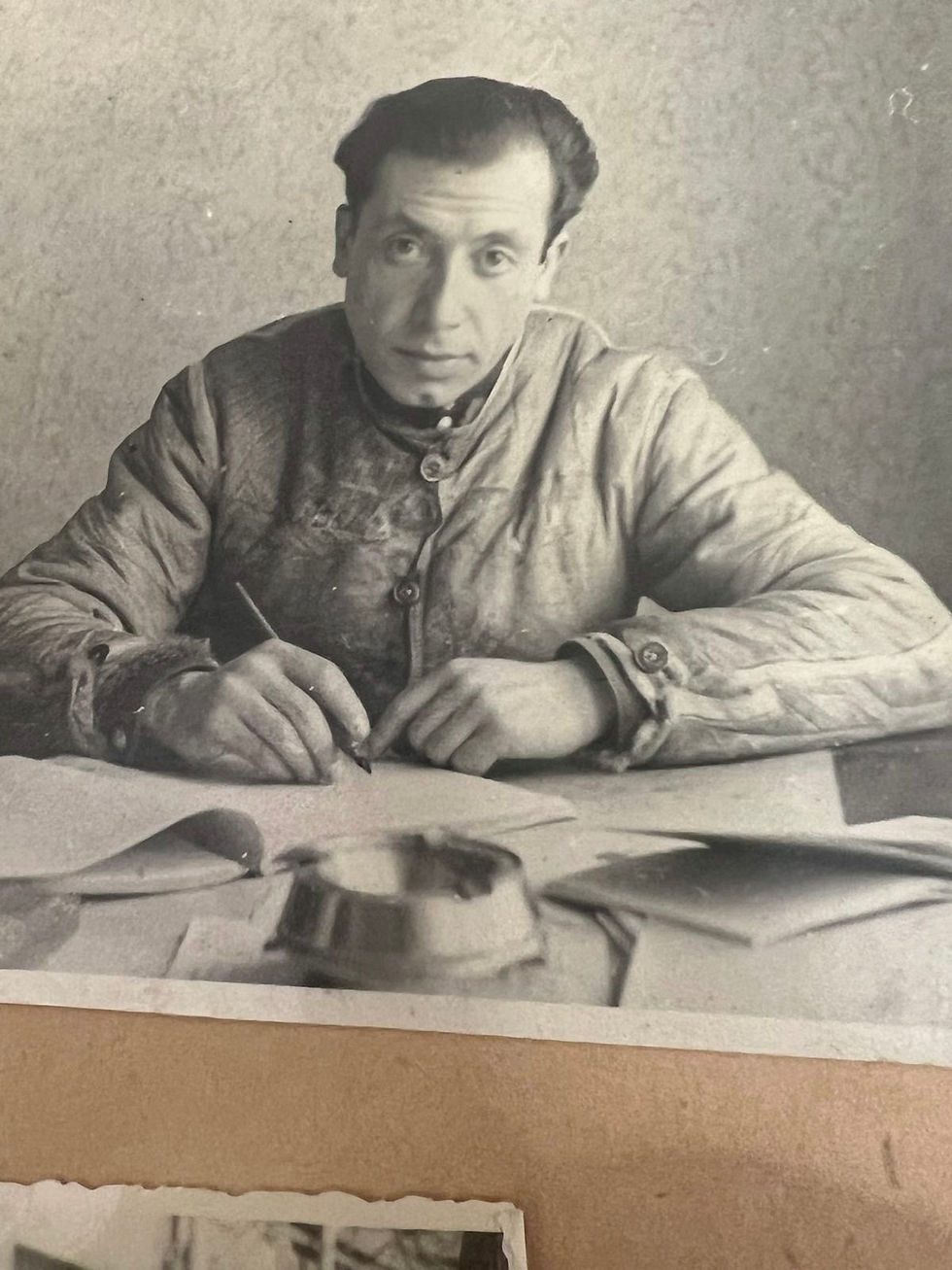
The Jewish writer Gershon Mazin was born in Riga into the family of Rabbi Michael Mazin and Beila Mazina (née Shur); he had an older sister, Khaya-Sima. The family lived in a suburb that until quite recently was known as the Moscow Forstadt–in the early twentieth century a poor and not particularly well-off area with a substantial Jewish population. After the early death of his father, Gershon abandoned heder, and at the age of twelve began to take an interest in Jewish politics. Like many Jewish teenagers in the Moscow Forstadt, he sympathized with the socialist Zionists and became an activist in the youth movement Ha-Shomer Ha-Tzair (“The Young Guard”), modeled on the Scout movement and preparing young people for aliyah to Eretz Israel and for a working life in kibbutzim–although he himself was denied permission to make aliyah three times at the time, as he was considered needed where he was. As his son recalled, several decades later Mazin was enthusiastically welcomed in the independent State of Israel by his former pupils, his hanikhim.
In independent Latvia, universal conscription was in force, and so at the very end of the 1920s (or the beginning of the 1930s) Gershon was drafted into the army for almost a year, where, according to family tradition, he served in the cavalry. In addition to Hebrew, the young man was fluent in Russian and Yiddish, which he loved and in which, it seems, he read extensively–Eastern Europe up to the mid-1930s saw a true flourishing of Jewish literature and the press, primarily in Yiddish. Gradually, Gershon himself began to write–the earliest work known to us, the poem “Negev,” was written in Hebrew and published in 1937 in the Riga periodical Eretz-Israel. In the mid-1930s he was offered a job as a translator in Kovno (Kaunas), the “temporary capital” of the Republic of Lithuania from 1920 (after the Vilnius region was transferred to Poland) until 1939. Mazin himself recalled in a letter to his wife during the war: “I remember arriving in Kovno as a translator on 150 litas, and six months later I was a deputy editor with a salary six times higher.” In another letter he recalled that he “wrote feuilletons for eight major newspapers.”
Apparently, he wrote these feuilletons under pseudonyms, since none have been found in either the Riga or Kaunas Yiddish press. In fact, in Latvia all Jewish publications except one were closed in 1934 after the coup d’état and the establishment of the authoritarian regime of Kārlis Ulmanis–possibly Mazin’s move to Lithuania was connected with this, especially if at that time, as we assume, he earned his living by translating from and into Yiddish. In Kaunas, however, Jewish cultural life was thriving–it is known that in the mid-1930s, in a city with a population of just over 100,000, about a third of whom were Jews, five daily Yiddish newspapers were published. The third most important among them was Das Vort, the organ of the socialist Zionist party Poalei Zion. It was here that Gershon Mazin held the position of “deputy editor” and, in 1938–1940, published–sometimes as “G. Mazin,” and sometimes under the pseudonym “M. Gershuni”--poems and prose essays “from Jewish life.”
His final piece was published on 14 June 1940–and the very next day Soviet troops entered Lithuania. Das Vort continued to appear for another couple of weeks and was then shut down along with all other “bourgeois” newspapers–Jewish, Lithuanian, Russian, and German.
Mazin moved back to his native Latvia, which was also occupied and soon annexed by the Soviet Union. In Riga he managed to find work as an inspitsient (that is, an assistant director) at the Riga Jewish Theatre, founded in 1926 and, after the arrival of the Soviets, reorganized as the State Jewish Theatre (GOSET). In one of his wartime letters from the front to his wife, Gershon recalls how, in addition to his main duties, he also played small roles in productions such as Mishpokhe Ovadis after Peretz Markish and The Street of Joy by the Soviet playwright Natan Zarkhi. It was at the theatre that Gershon met his future wife, Raya (Rachel) Westerman from Libau (present-day Liepāja). In Courland, the region in western Latvia with its center in Libau, Baltic Germans traditionally enjoyed considerable influence, and therefore Raya’s native language was German; she knew Yiddish, and especially Russian, much less well.
When Germany attacked the Soviet Union, the couple had to make a rapid decision–either to stay at home, as many Jews in the Baltic states did at the time, seeing nothing particularly terrifying in the German occupation, or to move quickly eastward, deeper into the Soviet Union. Fierce fighting for Libau, where Raya’s family remained, began on 22 June, and so her attempt to reunite with her relatives that same day was unsuccessful: fighting was already under way in the city, the train was stopped, and she had to return. Just a week later the Germans occupied both Libau and Riga. Gershon and Raya, however, managed to leave in time.
According to researchers’ estimates, about 15,000 Jews left Latvia in the summer of 1941–not counting those who did so against their will: just ten days before the German attack, the Soviet authorities deported more than 15,000 “socially dangerous” citizens of Latvia to Siberia; among them were about 1,800 Jews–almost 2 percent of the country’s entire Jewish population. Of the Jews who remained in Latvia, 70,000 were murdered by the Nazis.
As for the Mazins’ “evacuation” in the third week of June, the term can be used only with great reservation–for ordinary people nothing was organized, and they made their way to the eastern border as best they could, mostly on foot. Moreover, despite the fact that Latvia had already been officially annexed by the USSR for a year, this internal border was guarded, and at first refugees were not allowed to cross it; sometimes they were even put on trains and sent back to Riga.
In one way or another, Gershon and Raya managed to reach one of the main evacuation centers–Kirov. Most likely they eventually joined an officially organized train convoy: it is known that both the government of Soviet Latvia and members of the Union of Soviet Writers of the Latvian SSR were evacuated to Kirov. According to surviving recollections, conditions in Kirov were dreadful, which is hardly surprising: by the end of 1941 about a quarter of a million evacuees had arrived in Kirov Oblast, and 56,500 in the city itself, causing its population to increase suddenly by half. As in other evacuation centers, there was a catastrophic shortage of food, firewood, and housing. Because of poor sanitary conditions and the hardships of the journey, people fell ill and died.
Probably all these factors contributed to Gershon and Raya’s decision to leave Kirov and head south, to Central Asia. This was a very common choice, especially among refugees from the western regions of the USSR and particularly among Jews: they feared–quite rightly–the prospect of a cold and hungry winter. According to numerous memoirs, a significant role in shaping this perception was played by Alexander Neverov’s 1923 novella Tashkent–The City of Bread, known to many at least by its title, which describes a boy’s journey from the famine-stricken Volga region to Uzbekistan. According to official, though very approximate, figures, by the end of 1941 Jews accounted for 63 percent of all evacuees to Uzbekistan.
In one of his letters to his wife from the front, Gershon recalls this long journey from Kirov to Uzbekistan via Kazakhstan: “Do you remember our trip by cart from Chinabad to Pakhtakar? … Do you remember the nights in the Chinabad club, in Darbaz, at the station in Arys, at the evacuation point in Chimkent, and finally those inclement nights in Samarkand?” (unlike most refugees, the Mazins chose Samarkand rather than Tashkent). Neither Uzbek city, however, lived up to the evacuees’ hopes: housing was just as scarce there, and sanitary conditions were even worse. Food was somewhat more available, but decent products could be bought only at the bazaar and at sharply inflated prices. Winters were cold there as well, and firewood was almost harder to obtain than in Siberia or the Volga region, to which many of the Tashkent and Samarkand refugees began moving as early as 1943. The Mazins, however, stayed: Gershon scraped by on various odd jobs, while Raya found work in a hospital.
In March 1942, after several screenings and refusals, Gershon Mazin volunteered for the front. He was assigned to the 201st Rifle Division–a formation unique for its time, created by a special resolution of the USSR State Defense Committee on 3 August 1941:
“1. To accept the proposal of the Central Committee of the Communist Party (Bolsheviks) of Latvia to create a Latvian Rifle Division and include it in the Northwestern Front.
2. To instruct the Central Committee of the Communist Party (Bolsheviks) of Latvia and the Council of People’s Commissars of the Latvian SSR, jointly with the headquarters of the Northwestern Front, to begin forming the Latvian Rifle Division from among members of the former workers’ guard, militia, party and Soviet officials, and other citizens of the Latvian SSR evacuated to the territory of the RSFSR.
…
CHAIRMAN OF THE STATE DEFENSE COMMITTEE J. STALIN”


The division became the first to be manned according to a “national” principle–more precisely, it would be more accurate to say according to the principle of “geographical origin,” since far from all servicemen even of the first intake were ethnic Latvians. By December 1941, out of more than 10,000 soldiers (90 percent of them citizens of the Latvian SSR), 51 percent were Latvians, 26 percent Russians, and 17 percent Jews. According to a historical anecdote, the evacuated chairman of the Presidium of the Supreme Soviet of the Latvian SSR, Augusts Kirhenšteins, expressed bewilderment during the first inspection in September 1941: “Are Jews now considered Latvians?” (or, according to another version, “Is this a synagogue or a Jewish shop?”). In some units Jews constituted an absolute majority, and since many did not know Russian, training sessions were sometimes conducted in Yiddish.
It is possible that this was precisely what led to the official approval of the name “Latvian” in October–until then the division had more often been called “Latvian (Latysh)” (although in October 1942 it was renamed the 43rd Guards Division and once again “Latysh”). Historians believe that the creation of the division pursued primarily propaganda goals: it was meant to refute the widespread notion that the entire population of Latvia had been unanimously waiting for the Germans to arrive. This notion, of course, could hardly be called groundless–police battalions of Latvian volunteers fought as part of German forces in the Leningrad region in October 1941, and underground pro-Nazi paramilitary formations created under Soviet rule fully revealed themselves on Latvian territory itself as early as 22 June. The Latvian division was the response–later Lithuanian and Estonian divisions were created along the same lines, and then the Polish “Anders Army.”
At the time of Mazin’s conscription in March 1942, the division was fighting on the Northwestern Front in the area of Staraya Russa near Novgorod–and remained roughly in the same area until February 1943. In June 1943 Mazin told his wife about his combat experience: “After all, my military specialty is reconnaissance. I’ve already been behind enemy lines more than once and have captured quite a few ‘tongues.’ In addition, I had to lead an entire company into attack, and always successfully…”
But already in August 1942 Mazin was wounded and taken to a hospital, then wounded again, and in April 1943 he sustained such severe injuries that he was declared killed in action–and to this day is still listed as such in Russian and Israeli databases. Raya in Samarkand received a death notice, but according to family tradition she did not believe in Gershon’s death. Shortly before victory he wrote to her in Samarkand: “Today is a kind of anniversary for me. Exactly two years ago I was wounded for the last time. After that I lay for three days under bombardment in a hospital train in Bologoye. Oh, how bad it was for me then. There was very little hope of recovery, but worse than that was the fact that I knew nothing about you. After all, I received your first letter only in the third week of June 1943!” (“Hospital trains” were the special trains used to evacuate the wounded from the front line.)
After being discharged from the hospital, Mazin fought on the territory of his native Latvia as part of a new (but also “Latvian”) unit, the 308th Rifle Division–from this point on he appears in documents under the name German. On 13 October 1944 Soviet troops entered Riga. Two weeks later Mazin received a short leave and went to the city in the hope of learning something about his relatives. The Mazins’ prewar apartment turned out to be occupied by new tenants, and the janitor’s widow told him that his mother and sister with their family had been taken to the ghetto shortly after the Germans arrived and had not been seen since (it later emerged that the fate of Raya’s family was the same–after repatriating, she filled out witness testimony cards at Yad Vashem for all relatives, both hers and her husband’s). A day and a half later Mazin wrote to his wife: “I will do everything to build a new good life, a new family, worthy of continuing the line of our parents.”
The 308th Division fought until the very end of the war, finally taking part in the liquidation of the “Courland Pocket” in western Latvia, where the remnants of the Wehrmacht’s Army Group North were trapped. German remained in Riga, where Raya moved from Samarkand (no later than September 1945). In the summer of the following year their son Daniel was born–today he is a prose writer, publicist, and a member of the Israel Writers’ Union. As he recalls from his father’s stories, after the war German, who had a good command of German, obtained a position through the NKVD/MGB at one of the prisoner-of-war camps near Riga, where he was engaged in something like the screening of captured Germans: “reviewing cases and sorting them–who was actually a fascist, and who, although a fascist, at least had not committed war crimes.” Those who passed such screening were issued documents for departure abroad. Using his official position, Mazin could from time to time arrange false documents for his Jewish acquaintances–thus he helped Raya’s cousin, who had been arrested back in 1940.
After that, from 1946 to 1949, Mazin worked as an inspector for Gosstrakh. Around 1950 information reached him–most likely through acquaintances in the MGB–that his arrest was being prepared. He himself believed this was connected to a feuilleton about Stalin that he had published before the war in one of the Kaunas newspapers. However, according to the “Report on agent-operational work of the MGB of the Ukrainian SSR on intercepting channels of communication between Jewish bourgeois nationalists and abroad,” sent from the Ukrainian MGB to the all-Union ministry in the summer of 1950, attention was drawn to him as a correspondent of the Riga “Zionist newspaper Hadibur” (we were unable to find any trace of this newspaper), who “was connected with Iona Markovich Rodionov of the 2nd Main Directorate of the MGB of the USSR, arrested in December 1948, who was being developed on suspicion of espionage.”
According to this report, Mazin was to be arrested “for an attempt to forge a financial document.” In addition, “according to agent reports, MAZIN is anti-Soviet-minded and writes nationalist poetry.” A similar version of events appears in the testimony of Max Shats-Anin. In 1953 he–a well-known Latvian communist and figure in the Jewish labor movement–was arrested as part of the USSR-wide campaign of the “struggle against cosmopolitanism,” that is, repression directed against prominent Jews. Shats-Anin was subjected to an interrogation pattern already worked out in the 1930s, attempting to accuse him of leading a Latvian “Jewish Nationalist Center,” and during questioning on 2 March 1953 he named Mazin among the alleged members of this organization.
Be that as it may, in 1950 Mazin managed to secretly move from Riga to Stalino (Donetsk, Ukraine). For almost three years he lived there, apparently illegally, with relatives of his wife who took a great risk; the couple agreed not even to correspond. But in February 1953 Raya arrived in Stalino with their small son–and then German was finally found and arrested. Because the Donetsk archives are inaccessible, the details cannot be established, but as Mazin later told his son, “they beat me for a week, and then said: ‘you can go.’” Most likely this was connected with Stalin’s death, which occurred at just the right moment: Shats-Anin, too, was ultimately released, despite charges already having been brought.
The family lived in Stalino until early 1954. Because of the omnipresent coal dust, Daniel developed serious health problems, and the Mazins, taking up an offer from friends, moved to Odessa. There German became a feuilletonist for the daily newspaper Znamya kommunizma and also began writing plays in Russian–and this activity unexpectedly brought him great success. His second play, named after its main character, Lyuska, beginning in 1956 was staged in 72 drama theaters across the Soviet Union. It was a drama “about a girl’s coming of age in a family where the mother had survived the war, the father had been killed, and the stepfather worked in the police and was killed by bandits.” The play became so popular that in 1961 it was mentioned–albeit negatively–in a major column in Izvestiya by the doyen of the Soviet stage, Georgy Tovstonogov, chief director of the Leningrad Bolshoi Drama Theater. Reflecting on the public’s waning interest in the classical repertoire, he wrote: “A theater director I know shamefacedly admitted that he met his plan thanks to Mazin’s Lyuska–a petty-bourgeois melodrama…” Petty-bourgeois or not, Lyuska, together with another dozen plays, for some time provided the Mazin family with a relatively comfortable life through royalties.
As early as 1954 Mazin went on an official foreign trip to Vienna (which indicates that suspicions of political unreliability had been lifted). There, thanks to his prewar connections–one of his Riga comrades in Ha-Shomer Ha-Tzair had been Israel Halperin, later Isser Harel, the founder and then head of the Mossad–he managed to visit the Israeli embassy, where he was offered the chance to leave (probably directly from Vienna). However, it was impossible at that time to take his family with him, and German declined.
According to his son, in the late 1950s the KGB attempted to recruit Mazin, and when he refused, “they cut off his air supply”: his plays stopped being staged, and practically all that remained was his work at Znamya kommunizma. By that time, however, Mazin had acquired another occupation–he became a nationally known football “statistician,” that is, in today’s terms, an analyst.
In the late 1960s German gradually became involved in the Jewish repatriation movement, which intensified after the Six-Day War of 1967, helping people describe family ties (sometimes, with his literary talent, almost inventing them out of thin air), study Hebrew, and address other issues involved in preparing for aliyah. As his son recalls, “his renown in this sphere in Odessa was simply incredible. He was passed from hand to hand, and the stream of people coming into our apartment never ended.”
Eventually an invitation was sent to him as well–and it was sent by his then well-known namesake Max Mazin, who had fled Poland for the West after the war and become the head of the Jewish community in Spain (it was Max Mazin who, among other things, built the first synagogue in that country since 1492). Contrary to all expectations, the Mazins were finally granted exit visas, and in early 1972 they arrived in Israel.
Soon Mazin–once again Gershon–found a position at Israel’s first Russian-language newspaper, the weekly Nasha strana, where, as usual, he quickly rose to prominence. Unfortunately, he did not have much time left: on 2 April 1975, the 64-year-old Gershon Mazin died of a heart attack–his fourth. His obituary in Maariv was titled “A New Immigrant–a Veteran Zionist.”
29.12.2025
Author: Dmitry Shabelnikov
Translated by Lena Lores
Bibliography and Sources:
Gordon, I. Interview with Michael Mazin. 16 July 2025, unpublished. Archive of the project Jewish Heroes.
Information System Memory of the People of the Ministry of Defense of the Russian Federation.
Central Database of Shoah Victims’ Names, Yad Vashem.
Volkovich, B. Jewish Press in Latvia (1918–1940) // Materials of the 12th Scholarly Readings of the Faculty of Humanities, Daugavpils University. History. Vol. VI, Part II. Daugavpils: Daugavpils University Publishing House Saule, 2003.
Volkovich, B., Ferdman, H., Shteiman, I. Jews of Daugavpils on the Fronts of the Second World War. Daugavpils, 2000.
Kaganovich, A. The “Tashkent Front.” Jewish Refugees in the Soviet Rear. Moscow: M. Greenberg Library; Knizhniki, 2023.
Shneer, A. Latvian Rifle Divisions of the Red Army in 1941–1945 // The New Past, no. 4, 2020.
Shneer, A. Captivity: Soviet Prisoners of War in Germany, 1941–1945. Moscow: Mosty kultury, 2005.
Theatre. History of the Jewish Theatre in Russia and the Soviet Union // Electronic Jewish Encyclopedia (EJE). World ORT. 2006–2018.
Fuks, K. “Red Army Zionist Fighters” // Tablet, October 28, 2020.
Holmes, L. E. Stalin’s World War II Evacuations: Triumph and Troubles in Kirov. University Press of Kansas, 2017.
Manley, R. To the Tashkent Station: Evacuation and Survival in the Soviet Union at War. Cornell University Press, 2009.
Rosin, J. Kaunas // Encyclopaedia of Jewish Communities. Lithuania. Ed. Prof. Dov Levin; Assistant Editor: Josef Rosin. Yad Vashem, Jerusalem, 1996.
Investigation File No. 17281 of the KGB of the Latvian SSR on the charges against Max Yuryevich Shats-Anin and Frekha Shats, vol. 1, 18.02–26.04.1953. Latvian State Archive, Riga, fond 1986, file 2918 // Project J-Doc, https://jdoc.org.il/items/show/534
File No. 404. Reporting materials to the MGB of the USSR concerning Jewish bourgeois nationalists and Zionists, 1950–1952. Sectoral State Archive of the Security Service of Ukraine, Kyiv, fond 1, file 258 // Project J-Doc, https://jdoc.org.il/items/show/54
File of the 5th Section of the 2nd Directorate: “Materials of operational correspondence with the MGB of the USSR and regional UMGB offices concerning Zionists and Jewish bourgeois nationalists,” 23.01–23.12.1952. Sectoral State Archive of the Security Service of Ukraine, Kyiv, fond 1, file 259 // Project J-Doc, https://jdoc.org.il/items/show/55


