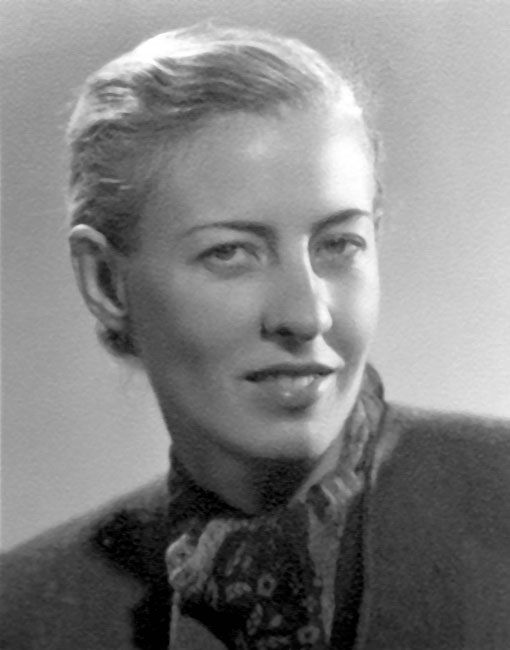
The heroine of this piece is unusual for our project. A pure-blooded Austrian, Ella Lingens-Reiner did not suffer under either Bolshevik or Nazi dictatorship because of her nationality. Moreover, she had every opportunity to build an excellent career as a physician or a lawyer and to live a relatively carefree life even under the inhuman Hitler regime. But “carefree” is the last word that suits our heroine.
This is not about the ability (or inability) to enjoy life when everything seems to favor it: when both a person and their loved ones are happy and the world is not shaken by bloody catastrophes. Alas, the mid-twentieth century was marked by the most terrible upheaval in history: tens of millions of victims, countries and cities destroyed. Yet even on the eve of the Second World War in Europe, people of very different ethnic and social backgrounds and means often faced a difficult moral choice: to extend a helping hand or to look away; to stand up in defense of the persecuted, innocent and weak, risking one’s own well-being, or to remain silent. In such situations Ella Lingens-Reiner did not hesitate. But let us go in order.
Our heroine was born on 18 November 1908 in Vienna. From childhood she showed remarkable abilities: she learned to read and write early, did well at school, and was diligent and attentive to detail. A love of animals, and of all living things in general (one cannot help recalling Ella’s famous compatriot, the philosopher and theologian Albert Schweitzer, with his concept of reverence for life) first awakened in young Ella an interest in biology, and later in medicine. A sensitive soul in her was combined with an inquiring mind inclined to analysis – hence her genuine interest in law. Later, as a student, Ella took a lively interest in politics and understood it well, sympathizing with the Social Democrats. She hated the fascism, Nazism, and xenophobia that were then raising their heads with all her heart.
Ella Reiner was forming as an extraordinary personality – well-read, with diverse talents. It cannot be said that her childhood and youth fell on cloudless years: the First World War, the fall of the multinational Austro-Hungarian Empire, the difficult decade and a half of the First Austrian Republic – in the economy, in everyday life of millions, and in politics, everything was extremely complicated. And yet Ella surely imagined her future life in vivid colors.
But a sinister shadow of Nazism was already looming over Europe: in Germany and in closely related Austria it was gaining more and more supporters. In January 1933 Adolf Hitler came to power in Berlin. Austria, too, was restless. The government of the conservative Engelbert Dollfuss, a member of the Christian Social Party who relied on big industrialists and the Church, provoked a conflict with the Social Democrats and in February 1934 crushed their uprising. A few months later a dictatorship was established in the country: the First Austrian Republic fell. The country was slowly but steadily sliding into fascism.
At that time, Ella Reiner was successfully studying medicine and law in Munich, Marburg, and Vienna and met her future husband, the German physician Kurt Lingens. They were united not only by profession, but also by political views: both were convinced anti-fascists.
In 1933 Kurt was expelled from all German universities for taking part in an anti-fascist student group, after which he moved to Vienna. Ella Reiner was then working in the legal advisory office of the Social Democratic Party in the Austrian capital and was a member of the executive body of the local party branch. With the fall of the Republic in 1934, the SDAP was banned; Ella joined an anti-fascist underground group led by the Socialists Otto and Käthe Leichter, a married couple.
On 7 March 1938 Ella and Kurt were married. There was no honeymoon for the newlyweds: only five days later an event occurred that definitively divided their lives into “before” and “after.” On 12 March 1938 Wehrmacht troops entered Austria and annexed it without a single shot. The young couple wondered whether they should emigrate. In the first period after the annexation this was relatively easy. And yet the Lingens decided: we will stay – at least for now. Could they imagine the challenges they would have to face?
From the very first days of the occupation, the Lingens couple began helping Jews – above all, students they knew. This help literally became vital during the so-called Kristallnacht, or Night of Broken Glass, on 9–10 November 1938.
The immediate pretext for these events was the death in Paris of German diplomat Ernst vom Rath after an assassination attempt by Herschel Grynszpan, a Polish Jew. The German state press responded to the attempt with openly xenophobic articles accusing Jews of hatred toward the German people, and the chief Nazi propagandist Goebbels declared: “…if a wave of popular indignation crashes down on the enemies of the Reich, the police and the army will not intervene.”
Within just a few hours after the news of vom Rath’s death, the silence of late November evenings in the largest cities of Germany and Austria was broken by the sound of shattering glass. It became a sinister signal: thousands of strong men and youths descended on synagogues and Jewish shops – and for the most part this was, of course, not some abstract, indignant “people” but SS storm troopers and members of the Hitler Youth dressed in civilian clothes.
In Vienna, where the Lingenses lived, 42 synagogues and numerous Jewish businesses were seriously damaged. At the height of the pogrom, which lasted almost a full day, Ella and Kurt hid ten Jewish families in their home. In Kristallnacht as a whole, 91 Jews were killed and several hundred were wounded. About 30,000 people were arrested and sent to concentration camps. Most of them were healthy young men. This decision by the Nazis pursued two goals: to limit the ability of German and Austrian Jews to resist and at the same time to begin the planned genocide.
Ella had never been under any illusions about the nature of the Hitler regime, but now the Nazis had finally thrown off their masks: their main goal was the complete annihilation of the Jewish people. It was precisely after Kristallnacht that the so-called racial purity laws were issued, depriving Jews of civil rights.
But the Lingenses were not alone in their attempts to resist the approaching darkness. In 1939 they met Baron Karl von Motesiczky, an anti-fascist whose mother was Jewish. He had also previously studied medicine at the University of Vienna. In the baron’s estate in Hinterbrühl, a suburb of Vienna, Jews and members of the anti-Nazi resistance often found shelter. Ella and Kurt became friends with Karl, and for the summer Baron von Motesiczky invited the Lingenses to stay with him. At that time fresh air was especially beneficial for Ella – she was expecting a baby. On 8 August 1939, in the house of von Motesiczky, Ella and Kurt’s son, Peter Michael Lingens, was born.
Meanwhile, Nazi Germany had gathered its strength for a global slaughter: on 1 September 1939, with its attack on Poland, the Second World War began. In the spring and summer of 1940 Denmark, Norway, the Netherlands, Belgium and finally France were occupied. On 22 June 1941 the Reich launched its war of conquest against the Soviet Union. To the hundreds of thousands of Jews and anti-fascists – prisoners of concentration camps from Germany, Austria, and Czechoslovakia – were soon added millions more from countries of Western, Eastern, and Southeastern Europe occupied wholly or in part.
By now the Lingenses understood perfectly well that they faced long and extremely dangerous work. Perhaps at times they thought about escape – for example, to neutral Switzerland. But the couple realized that they were needed at home; here they had the possibility of saving many people.
Over the course of several months in 1941–1942, the Lingenses hid a young Jewish woman, Erika Felden, in their home. Friends helped them: a married couple whose work was connected with the distribution of food ration cards provided Erika with supplies. Using the identity papers of the Lingenses’ housekeeper, the sick young woman received medical care and even underwent surgery.
The Lingenses’ home became a real refuge for their Jewish friends: some entrusted them with valuables for safekeeping, others asked the Lingenses to put them in contact with couriers and help them escape the Nazis. One such courier was the Jew Rudolf Klinger, a former actor. As it later turned out, he was a traitor who informed the Gestapo about the activities of the Lingenses and Baron von Motesiczky. In 1942 their acquaintance Alex Weissberg-Cybulski, a Jew hiding in Kraków, approached Kurt and Ella. He asked them to help him and his friends get to Hungary. Klinger volunteered to accompany these people to the border…
In August 1942 Weissberg-Cybulski sent to Vienna the brothers Bernhard and Jakob Goldstein with their wives, Helen and Pepi, in order to have them taken to a safe place. Klinger brought the fugitives to the border, but at the last moment handed them over to the Germans. On 13 October 1942 the Lingenses and Baron von Motesiczky were arrested. Kurt Lingens was immediately conscripted into a military unit being sent into the fiercest slaughterhouse – the Soviet front. There he was seriously wounded. Karl von Motesiczky, after four months in prison, was sent to Auschwitz, where he died of typhus on 25 June 1943.


On 5 February 1943 Ella was sent to the women’s section of the Birkenau-Auschwitz concentration camp. She was assigned the number 36,088. Even there she was able to be of help to people, saving lives as a prisoner-physician. Later Ella recalled in her memoir, Prisoners of Fear: “We hid women somewhere in the barracks – the SS ordered us to call out names from the files in the hospital registry. We secretly transferred them to ‘Aryan’ barracks or to places where the selection had already taken place. We would add their names to the list of patients due for discharge and send their cards to the office for processing the documents – the Nazis had forbidden any discharges from the hospital on selection days.”
It is hard to put into words the feelings of the prisoners and their attitude toward Ella: to them she was truly an angel, extending a helping hand in the midst of hell.
In 1943 Ella herself was on the brink of death: she fell gravely ill with typhus. At this critical moment she was helped by Werner Rohde, an SS Obersturmführer and physician in the Buchenwald, Natzweiler-Struthof, and Auschwitz concentration camps. Before the war Ella had studied medicine at the University of Marburg together with Rohde. Werner transferred Ella Lingens to the infirmary of the main Auschwitz camp and then led a campaign to improve hygienic conditions in the women’s camp.
According to the recollections of some prisoners, Werner Rohde was not entirely devoid of humanity. He was involved in the deaths of thousands of inmates: he personally gave the order to kill several dozen Polish boys from Zamość by phenol injection; he forced prisoners to take hard drugs – morphine and hexobarbital – and when many died, he called their deaths “amusing.” Yet at times Rohde used his power to help people. Ella Lingens gave his figure an unambiguous assessment: “He saved my life, but he also sent tens of thousands of people to their deaths. All those who tried to ease their lot in this way were killed without hesitation in other cases.” After the war Werner Rohde was tried and, in 1946, sentenced to death by hanging.
Hardly recovered from her illness, Ella returned to her duties. Emaciated and weakened, she still did not allow herself to work fewer than 12–13 hours a day.
In December 1944 Ella Lingens was transferred to Agfa-Kommando, one of the women’s satellite camps of Dachau. There she retained her position as camp doctor and even gained more freedom than in Auschwitz.
Conditions in Agfa-Kommando proved better than in the main Dachau camp. About five hundred women (193 from the Netherlands, 10 from other Western European countries, the rest from Eastern and Southeastern Europe) were used by the Nazis as forced laborers at Agfa – formerly a camera factory in Munich-Giesing, a southwestern suburb of Munich, 23 kilometers from the main Dachau camp. The prisoners assembled ignition timers for bombs, artillery shells, and the V-1 and V-2 rockets.
Fully aware of what they were being forced to work on, the inmates of Agfa-Kommando did everything they could to sabotage production. Ella Lingens supported them through the opportunities her position as a physician gave her.
In January 1945 the road between the main Dachau camp and Agfa-Kommando became impassable because of constant Allied bombings. The camp’s food supply was disrupted. Driven to despair by hunger, exhausting labor, and recurring outbreaks of disease (typhoid fever, scarlet fever, and tuberculosis were rampant), in January 1945 the Dutch prisoners declared a strike – an unheard-of act in a concentration camp. The inmates showed incredible solidarity. Production stopped. Gestapo officers arrived urgently and conducted an investigation, but were unable to find the initiators. As a result, one of the strikers – Mary Weidders, chosen at random – was placed in solitary confinement for seven weeks.
Ella Lingens also fell under strong suspicion: the Nazis knew very well about her aid to prisoners back in Auschwitz. But the lack of evidence, along with her background, worked in her favor. Later Ella wrote that only a combination of what diverted fascist eyes – her “Aryan” origin, which eased her conditions of imprisonment – together with professionalism and inner strength, a readiness to work to the point of exhaustion, helped her survive in the camps.
However, Ella’s situation in Agfa-Kommando deteriorated significantly: the authorities no longer trusted her and tried to shield her “from excessive contact with prisoners inclined to disorder.” In mid-February 1945 Ella Lingens submitted a request to the administration to be transferred to the main Dachau camp (the reason for this request remains unknown to us).
After Dachau was liberated by the Americans on 29 April 1945, many journalists and reporters arrived there. “They tried to understand what was happening here,” Ella recalled, “in order to tell the world about it, although probably no one who has not experienced all of this personally will ever be able to understand it fully.”
After being liberated from Dachau, Ella returned to Vienna. She completed her studies at the University of Vienna and then worked in several clinics and government institutions. Ella devoted much time and effort to informing the public about the consequences of National Socialism and about her experience working in a death camp: she gave lectures in schools and universities and worked on her memoir. In postwar Austria her activity was particularly relevant, since the country’s National Socialist past was being hushed up by the authorities. In 1973 Ella retired and took the position of adviser to the minister in the Federal Ministry of Health and Environmental Protection.
In 1948 Ella Lingens-Reiner published her memoir Prisoners of Fear, in which she described the horrors of the concentration camps and the steadfastness and extraordinary courage of their inmates. These qualities helped them preserve remnants of warmth, humanity, and dignity even in the midst of utter hell.
Ella Lingens’s book is of great value for studying the deep social and psychological roots of Nazism. The reader encounters the figures of Nazi executioners – not caricatured bearers of “absolute evil” from propaganda, but living people with their own weaknesses and oddities. And that makes them all the more frightening.
Earlier the physician Werner Rohde was mentioned – a murderer of thousands of innocents who was “at times inclined to show kindness.” Even greater horror is inspired by the figure of Maria Mandel, head of the women’s section of the Auschwitz-Birkenau camp. As Ella Lingens recalled, “this attractive, tall, and strong woman with beautiful golden hair and blue eyes could easily be imagined as the successful proprietor of a country inn and at the same time a butcher’s shop, surrounded by happy family members.” Moreover, Maria Mandel loved music and even ordered that a women’s orchestra be formed from prisoners, which greeted new arrivals at the camp gates with cheerful music. The orchestra was led by the Austrian violinist of Jewish origin Alma Maria Rosé, the niece of composer Gustav Mahler. Maria Mandel called Alma her friend and repeatedly declared that she would be the last of all ever to be sent to the gas chamber. When Alma Rosé fell ill, Mandel ordered the prisoners to carry the violinist to her own room. In a certain sense the head of the women’s section kept her promise: on 5 April 1945 Alma Rosé died not in the gas chamber but of illness.
And Mandel also “loved children.” Ella Lingens describes a scene in which four Jewish toddlers stand with their mothers at the commandant’s door (the mothers in despair because they do not know why their little ones have been summoned). Maria Mandel invites the children in and, a few minutes later, sends them out with pieces of cake and sweets. How touching, isn’t it?..
But this same Maria Mandel – this hearty Austrian “housekeeper,” radiating health and strength – was marked by utterly blind devotion and love for the Führer. Before being transferred to Auschwitz-Birkenau, she had “made a name for herself” at the Ravensbrück camp through her abuse of prisoners. In Auschwitz-Birkenau, Mandel personally carried out selections and sent thousands to the gas chambers; in all, she was responsible for the deaths of about 500,000 women and children. In November–December 1947 Maria Mandel appeared before the court as one of the principal defendants in the First Auschwitz Trial. She was sentenced to death by hanging, and on 24 January 1948 the sentence was carried out.
Reflecting on such examples, Ella Lingens arrives at an important and at the same time shocking conclusion: the line between a rational, kind being and a ruthless monster within a person is extremely thin. Efficiently organized propaganda can, in just a few years, turn thousands of people who in ordinary circumstances are merely inclined to violence (some of whom, Ella writes, might otherwise have become psychiatric patients) into bloodthirsty monsters realizing their mad fantasies. No fewer are those who are completely indifferent to the suffering of others. Under a Nazi dictatorship, it is precisely such people who “rise” and gain the power to decide who will live and who will die – a truly terrifying, devilishly seductive temptation.
In early March 1964 Ella gave testimony as a witness during the Second Auschwitz Trial (held in Frankfurt am Main) against Nazi executioners who had worked in the Reich’s largest concentration camp. For many years she served as president of the organization of former Auschwitz prisoners (Österreichische Lagergemeinschaft Auschwitz). In 1980 Yad Vashem in Jerusalem awarded Ella Lingens-Reiner and Kurt Lingens the honorary medal of Righteous Among the Nations.
Ella Lingens-Reiner died on 30 December 2002 in Vienna. Her son Peter Michael Lingens later recalled, “A few days before her death my mother once again got out of bed. She leaned along the walls of the room and the long hallway and suddenly stopped in the doorway of the living room, apparently somewhat confused. …She kept repeating one sentence, her eyes widening with fear: ‘You won’t burn me? You won’t burn me, will you?’”
It is evident that Ella Lingens-Reiner’s time in the concentration camp was a monstrous, unimaginably traumatic experience. Even in the soul of such a courageous woman it could not fail to leave a grievous wound – a kind of “black hole,” quieted over time but always alive as a source of fear.
Back then, in the 1940s, amid barbed-wire-ringed barracks packed with tens of thousands of prisoners, Ella fought her fear every single day. And her reward for this was the hundreds of lives she saved. The inner light of Ella Lingens-Reiner – her kindness and humanity – will always live on in the descendants of those who escaped from hell thanks to her.
31.12.2025
Author: Mikhail Krivitsky
Translated by Lena Lores
Bibliography and sources:
Ella Lingens. Prisoners of Fear. London, 1948.
A. Gadzinski. Kalliope Austria: Frauen in Gesellschaft, Kultur und Wissenschaft. Vienna, 2015, p. 60.
“Lingens, Ella, née Reiner” // biografia: Lexikon österreichischer Frauen. 2016, vol. 2, pp. 1993–1994.
Esther Ginzburg. “Doctor Ella. On the 115th anniversary of the birth of Ella Lingens” // Jewish Panorama. Independent Monthly Newspaper. Jewish Panorama :: 11 (113) November 2023 :: Doctor Ella
S. Steinbacher. Dachau – die Stadt und das Konzentrationslager in der NS-Zeit. Die Untersuchung einer Nachbarschaft. Munich, 1993.
Dachau. Holocaust Encyclopedia. United States Holocaust Memorial Museum. Dachau | Holocaust Encyclopedia
Ernst Klee. Auschwitz, die NS-Medizin und ihre Opfer. 3rd ed., Frankfurt am Main, 1997.
Hermann Langbein. Menschen in Auschwitz. Frankfurt am Main, 1980.
S. V. Aristov. Everyday Life in Nazi Concentration Camps. Moscow, 2017.
Hans Mommsen. The Nazi Regime and the Extermination of the Jews in Europe. Moscow, 1980.
Ella Lingens-Reiner
1908 – 2002